PostnHost: The Best Multilingual CMS for Rails
Rails teams rarely need another detached content platform. They need a publishing system that understands the application they already have: its routes, deployment model, authentication, design system, and conventions. PostnHost takes that approach. It is an open-source, mountable Rails CMS engine designed for multilingual publishing and search-friendly content without forcing your team to maintain a second stack.
If your product serves more than one market, “add a language field” is not a complete localization strategy. Every translation needs its own content and metadata, visitors need predictable locale-aware routes, and search engines need clear signals about which version belongs to which audience. PostnHost brings those concerns together inside Rails.
Why multilingual publishing becomes complicated
A single-language blog can start with a title, a body, and a slug. Multilingual publishing adds a new layer of operational questions:
- Which language is the source of truth?
- How do editors see which translations are missing or out of date?
- Should every locale have its own title tag and meta description?
- How are canonical URLs, alternate-language links, and sitemap entries generated?
- Can the editorial team publish one translation without accidentally changing another?
These are not just editorial details. They affect discoverability, maintainability, and the experience of every international visitor. A general-purpose headless CMS can solve parts of the problem, but it also introduces API clients, webhook handling, preview infrastructure, and another deployment boundary. PostnHost keeps the content workflow close to the Rails application that serves it.
A CMS that behaves like Rails
PostnHost is packaged as a Rails engine. You add the gem, run the installer and migrations, and mount it inside your application. The public site and editorial dashboard use familiar Rails building blocks, with Hotwire for interaction and server-rendered pages by default.
# Gemfile
gem "postnhost"
bundle install
bin/rails g postnhost:install
bin/rails postnhost:install:migrations
bin/rails db:migrate
That architecture matters. Your team can use the same observability, hosting, backups, asset pipeline, and release process it already trusts. There is no JavaScript SDK between the application and its content, and no hosted vendor becomes a required runtime dependency.
Multilingual SEO is part of the product
PostnHost treats each language version as publishable content, not as a loose collection of translated strings. Editors can manage localized titles, article content, title tags, Open Graph titles, schema headlines, excerpts, and meta descriptions. Public routes are locale-aware, and the generated sitemap and alternate-language metadata help search engines discover the correct version of each page.
The result is a cleaner workflow for international SEO:
- Localized URLs give each audience a stable, shareable page.
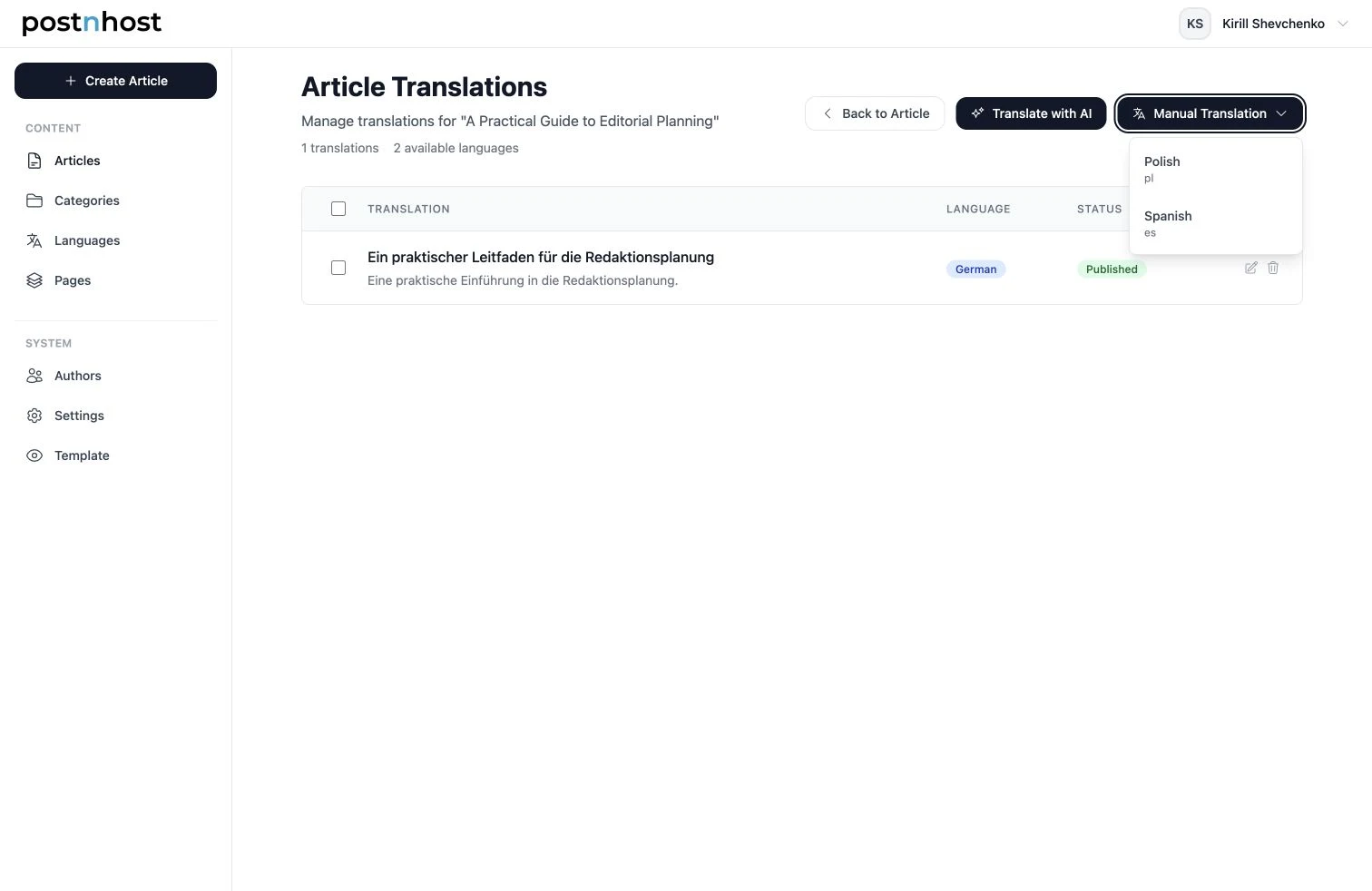
- Language switching connects visitors to available translations.
- Hreflang metadata identifies alternate language versions.
- Localized SEO fields let editors write for people instead of reusing machine-translated metadata.
- Automatic sitemap generation keeps published content discoverable as the site grows.
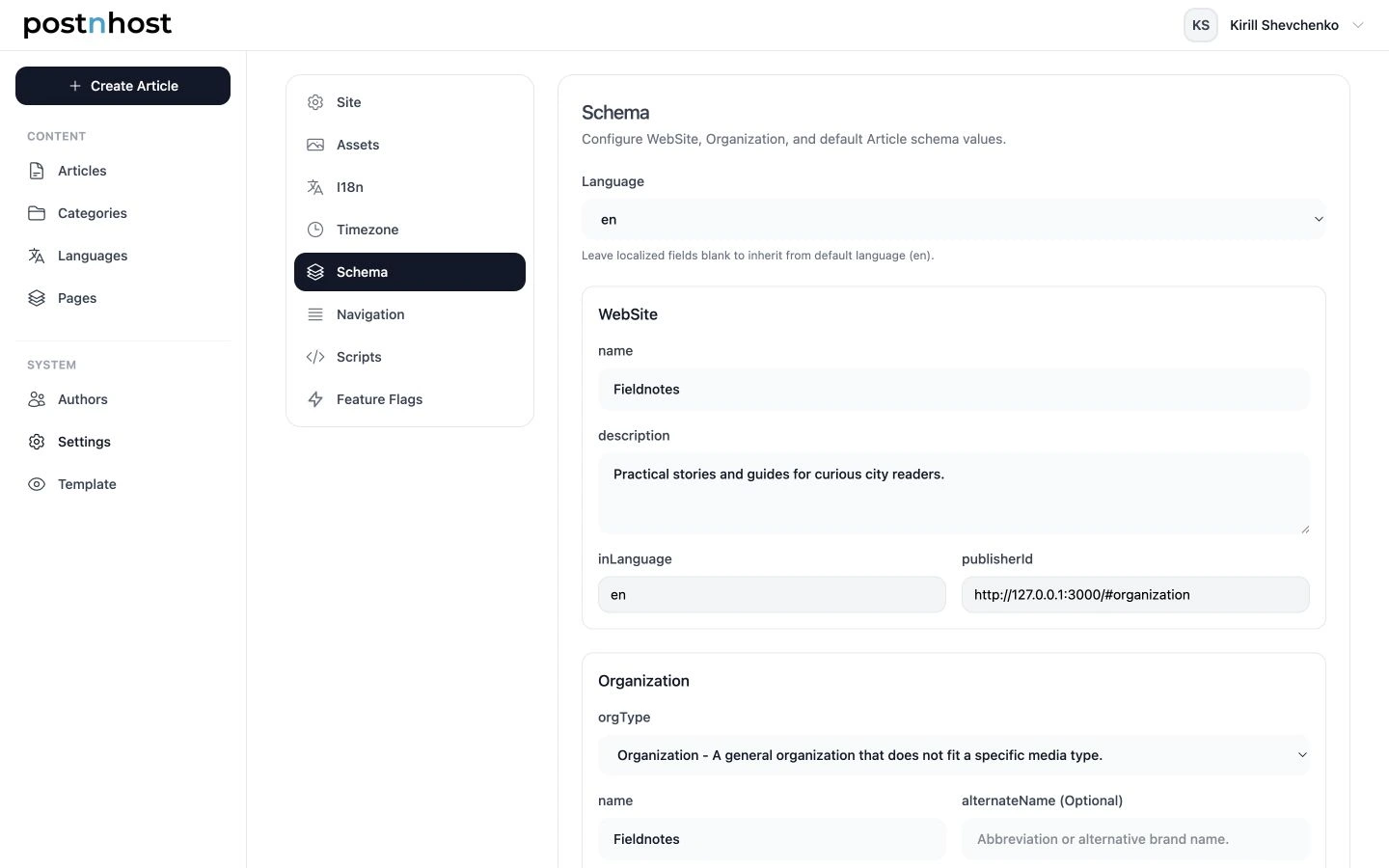
AI-assisted translation is available when configured, but it is optional. Teams retain control of the editing and publishing workflow, which is essential when tone, terminology, and regional nuance matter.
Editorial tools without leaving your application
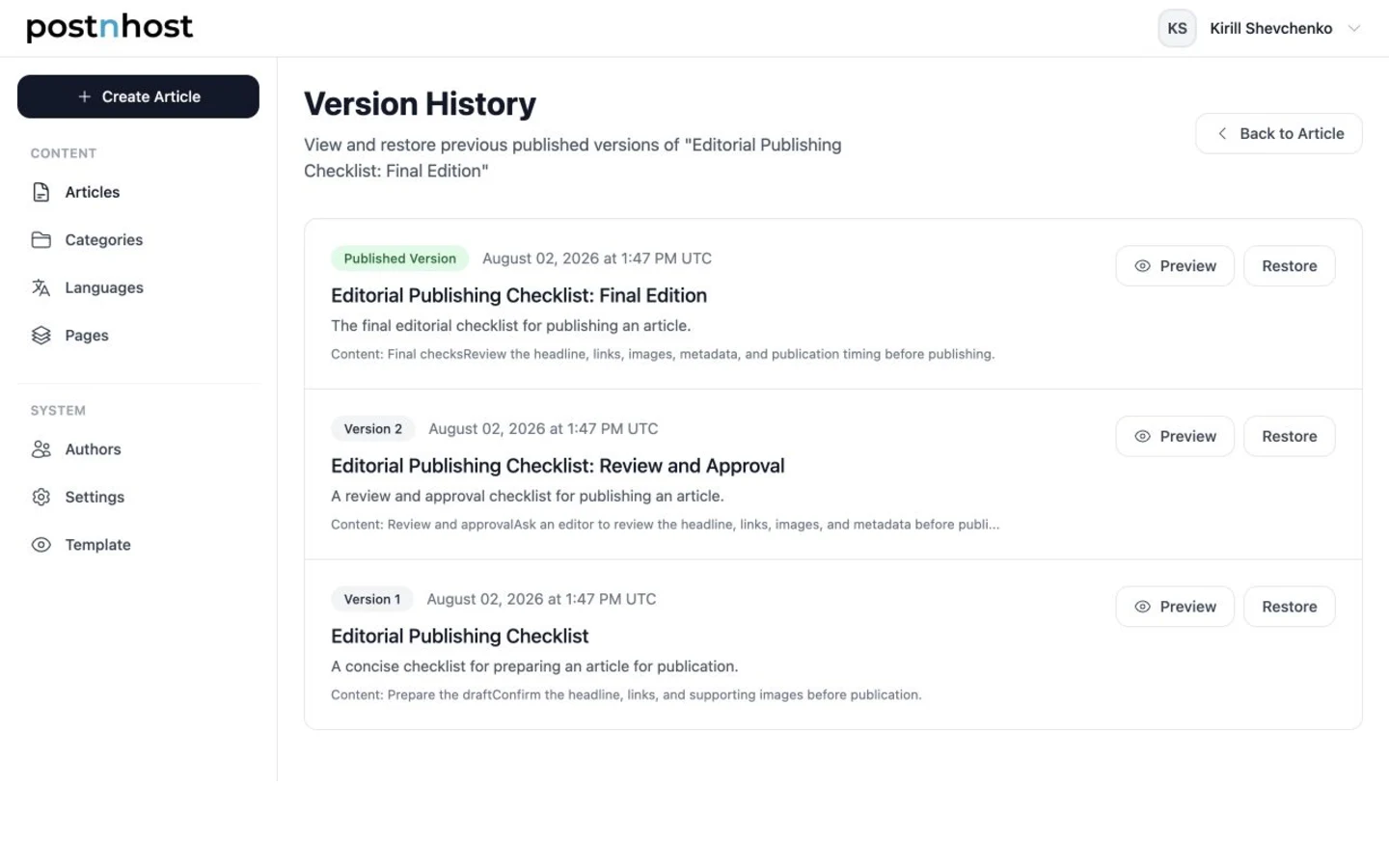
A multilingual CMS still has to be pleasant to use every day. PostnHost includes a TipTap-based rich-text editor, optimized image handling, drafts, scheduled publishing, version history, rollback, categories, suggested articles, and multi-author bylines. Editors get a focused dashboard, while developers keep the implementation in a codebase they can understand and customize.
Publishing uses snapshots, so the public site serves an intentional published version while editors continue working on later changes. That separation is especially useful for translations: a draft update does not have to replace the live page until it is ready.
Own the presentation and the data
PostnHost ships with multiple public templates, but it does not lock a Rails product into a fixed theme. Views can be copied into the host application and adapted to its design system. The engine supports standard Rails asset setups, including Propshaft and Sprockets, and host-side Tailwind compilation is available for deeper template customization.
The same principle applies to infrastructure. You can mount PostnHost in an existing application or start from the preconfigured self-hosted app. The reference app combines Rails, SQLite, Solid Queue, Solid Cache, Litestream backups, and S3-compatible image storage in a compact deployment. Teams that prefer a different database or hosting shape can integrate the engine into their existing Rails architecture.
How PostnHost compares with a headless CMS
A hosted headless CMS is a sensible choice when many unrelated clients need to consume the same content API. For a Rails-led product, however, that flexibility often comes with extra moving parts: schema synchronization, preview tokens, client caching, webhook retries, and duplicate rendering logic.
PostnHost is strongest when Rails is already the center of the product. It gives the team an integrated editing experience and a conventional server-rendered public site while preserving the ability to override views and extend behavior in Ruby. The tradeoff is deliberate: it optimizes for Rails ownership rather than platform neutrality.
Who should choose PostnHost?
PostnHost is a strong fit for SaaS products, developer tools, agencies, and content-led businesses that:
- already run Rails and want content to live inside the same application;
- plan to publish in multiple languages;
- care about localized metadata, structured data, and search visibility;
- want editors to manage drafts, schedules, images, and revisions without developer help; and
- prefer open-source software and self-hosted infrastructure over a recurring CMS dependency.
The best multilingual CMS is the one your Rails team can own
“Best” depends on architecture. If your content must serve many frameworks through a central API, a headless platform may be the right tool. But when Rails already owns the customer experience, PostnHost offers a compelling alternative: multilingual publishing, localized SEO, editorial safeguards, and complete control in one native engine.
Explore PostnHost, review the source on GitHub, or start with the self-hosted Rails app. For Rails teams ready to publish globally without building a CMS from scratch, PostnHost is an unusually natural fit.